Friday, May 20, 2011

In which I confess my secret

(This entry is about one of my major failings as a teacher. I assure you that I am not fishing for compliments or anything from the community here--just needing to get it off my chest.)

It's finals week at our school and this brings up one of the most shameful aspects of my classroom.

My students consistently do poorly on standardized tests.

The two sections of precalculus that I teach have, in local lingo, Common Course Exams. The district writes the exams for all precalculus students in the county to take and this counts as the final exam for every precalculus course (no curve). It consists of 50 multiple choice questions and we teachers are not meant to look at it until we are handing it out to students to take.

This year, my averages were 41% (high of 74%; 21 students took the exam) and 45% (high of 70%; 19 students took the exam) for the two sections I teach.

The issue doesn't just start there, though. For other courses I've taught with these CCEs in the past, the same issue has arisen. And most ashamedly, in my students' AP scores. Last year, for example, not a single one of my 19 Calculus AB kids passed with a 3 or better on the AP exam.

What makes me feel worst about this is that I don't know why this is an issue for my classes.

I have a list of excuses below, but ultimately I feel like I am: 1. Misrepresented by the data (which has cost me the chance to teach calculus next year since the principal is not happy with the scores from my previous classes) and B. Letting down the students who do seem to be trying.

Some excuses:
  1. I do not get to see the exam before it is given, so I cannot easily prepare students for what is expected
  2. I teach mostly seniors, so many of them are not focused at the end of the year
  3. At our school, seniors can be exempt from the final exam if they: A. Have an A in the class and B. Have not missed more than 6 days of school. This will bring down my class averages since the best students will not be taking the exam.
  4. Alternatively, students may be exempt from the final exam if they take the AP exam (regardless of how seriously or whether they are seniors or what their grade is in the class or attendance). This artificially lowers my AP scores since many students (who admit it before going in) will sign up to take the AP exam just so they can be exempt from the class exam.
  5. Many students who are already failing in my class have just "given up" on the class and do not even attempt the exam. Still others play the numbers game and calculate things like, "I can still pass the class (or maintain a B) if I get a 25% on the exam."
  6. The exam was 50 multiple choice (4 choices) questions to be finished in 2 hours. Every question missed lowers the grade by 2%, so to get an A, for example, you can only miss 4 questions.
  7. The same CCE is given to both honors and standard levels. What's more, the exam was written by 3 teachers who have exclusively honors level classes. I teach all of the standard level classes at our school. The honors teacher had an average of 66% (high of 86%)

Rebuttals to excuses above:
  1. This is an issue for every teacher and not all are having the same results as myself.
  2. This, too, is not specific to my classes. Also, if the students know the material well enough, this shouldn't be a very big issue
  3. In the class with the 45% average, I had at least 4 juniors with an A in the class who were not exempt.
  4. This is a big issue and a problem I have with our district's policy. It still does not account for all students and having none pass last year is abysmal.
  5. This does not account for all students, and I know many of them worked hard to review and of the 2 hour exam, most took at least 80 minutes, so they thought about it some.
  6. Most students took between 80 and 110 minutes to finish the exam. Nobody was still working at the bell, so time did not seem like a true issue (although they may have been watching the clock and gave up a few minutes early).
  7. We are still in the middle of exams, so I don't know what other numbers from the county may be like. The honors teacher's numbers seem more reasonably explained by these excuses than my own.

So, I don't know what to do about this. Whenever I get results like these back (which is too often), I get depressed and want to give it up. Not teaching, because I couldn't give that up, but maybe these "new fangled methods." If I'm going to be judged on standardized tests, maybe I should go with the tried-and-true methods of drilling homework for grades and a standard quiz/test system that gives students one high-stakes chance to get it right.

I don't know. I'll have all summer to get over it (until AP scores come in, I guess) and should come back around. I know my students know the material. They have it mastered from what I can tell in class, but they can not show it when the data counts. I took it as flukes the first couple years of this happening, but now it has become a pattern.

Altruistically, I know my students are learning and enjoying learning. They master all of the skills on the curriculum and then some. They are challenged and enjoy me as a teacher. An interview with ANY of my students (even those who gave up on the class and failed) would let you know what kind of teacher I am. Ultimately, they learn and that's what counts. I just hate that I may end up a martyr for it.

Wednesday, May 18, 2011

Baby's First WCYDWT


Our little baby's all grows up!


A couple weeks ago, it was (unexpectedly) senior skip day at my school. I found myself with no more than a half dozen kids in class and was torn about whether to actually teach/review something or do something more “fun.” (It’s sad that I, too, separate the two too often.)

This was my opportunity to try out something I’ve seen all over blogs and have wanted to do, but never got around to it. It’s a classic story in math circles and that’s all I told on that day (not having more ready), but I thought I’d update it with more modern visuals. You will already recognize the story by having glanced at the pictures below, but many students have not heard this yet by the time I see them in their lives, so it will still be novel to them, but the questions may venture in different directions.

I think a “pure WCYDWT” would mean just presenting the pictures. Of course, this one comes with a cute and somewhat compelling story (especially if you include the “ending” that the emperor of India realized what was going on by about the 20th square and executed the man--these age kids love death), so you should gauge your own class as to whether you tell the story or not. I think the lesson will go similarly either way.

If you’re not tied to the story, though, doing this with pennies would be another interesting way to go (especially if you don’t mind getting a little political and talking about our national debt and other large money numbers). There is much less variability in the measurements and the visuals could be created more easily (and is more familiar to more students than rice). There are more extensions to other forms of currency (with pictures to be found on the internet fairly easily) and they all stack fairly nicely.

Here is the opening picture:


And some other angles:


Some other useful pictures that can be revealed if questions take such turns:


A few grains for scale


And to get the other side?


Different kinds of rice


40kg bags of rice


Somewhat political in nature, but good visualizations of rice in piles


Rice plant


Rice paddy


I did it in my two standard precalculus classes and they each went in slightly different directions with it. In one class we got to the large scale by using the weight of a grain of rice (see the bottom of this page), then envisioning a 10lb bag of rice as a backpack. In the other class they didn’t know what a 10lb bag looked like (and google images is blocked at school), so we happened to find that the average length of a grain of rice was about 7mm and then just assumed it was a sphere (clearly too big, but we justified it by saying it puffs up when cooked and that might account for some of it and we truncated most of our decimal answers).

After we got to the large scale, the class who used the weight was more interested in the ability to produce the rice. The second class was more interested in how to consume the rice.

Our district is VERY strict about internet censorship, so my computer is the only one in the room that can access the internet (the kids could use their phones, but that’s also against school policy). Even my computer is blocked from such useful resources as google images and wikipedia, so we had to make do with what we had. So, I looked up what I could on my computer, but this would’ve been much more fun and interesting in smaller groups of students or if each student had his own computer to pursue his own questions.

By the nature of the problem I couldn’t get a picture of “the answer” so that’s perhaps somewhat unsatisfying. My students trusted the basics of the math, though, and I didn’t have any problems with this in class.

The questions I expected (and they asked)::

  1. How much rice is already there?
  2. How many are on the last square?
  3. How much rice would it take to finish the board?
  4. How long did it take you to make that?
  5. How much room would that take up?
  6. What’s the volume of a grain of rice?
  7. How big is this room? (counted 1’x1’ floor tiles and cinder blocks on walls)
  8. How big is the school? (some tennis athletes in the room said it was 0.7mi to run around, then we estimated school has a square floor plan)
  9. How big is Tennessee?

  1. Along the line of thinking, “Could we grow that much rice on the planet?”
    1. How does rice grow?
      1. How many grains does a single plant produce?
      2. How much room does a plant need?
      3. They grow in water? Can we look up a picture?
      4. How much water is in a “paddy?”
      5. Where can rice grow?
    2. How much rice does China already grow? How much in the US?
  2. Along the line of thinking, “What would the guy do with it?”
    1. How much rice do people eat per year on the planet already?
    2. How do we already store rice?
    3. How big is this guy’s chess board?
    4. How long would it take them to count them all out?
    5. How much bigger is a cooked grain than a regular one? (my wife found this article)
  3. Along the line of thinking, “Let’s go on a tangent trip!”
    1. Do birds really explode if they eat uncooked rice?
    2. If I make some rice, can we have a party? Can we order Chinese food?!


Some of my own questions brought up by theirs:

  1. Does rice dumped in a pile always form a similar cone? If so, what are the relative dimensions? (thinking about calculus related rates problems here where that is often a given in the setup)
  2. I know there are experiments that do things like “rice avalanches” to simulate landslides and such. I should look into this for fun tangent ideas to this.
  3. If I wanted to get the exact volume of a rice “ellipsoid,” how could I derive that formula? (And would it be accessible to precalculus students)
  4. Obvious packing problems.

Other interesting things:

  • When I asked for estimations on how much rice there would be in total, all students thought it would fit within our school and most thought it would fit in our classroom. So, the end result was both interesting and shocking.
  • Many students were bothered by the “estimation” parts of this and wanted a single, correct answer as in their entire math career to this point.
  • While looking up the length of a grain of rice one of the first hits was for a math “word problem” that said something like, “If the length of a grain of rice is 1mm....” I told the class, “Well, this is coming from a word problem, so I’m not sure if we can trust this. Let’s keep looking.”
  • Most students wish we could do this every day. It was interesting and they learned! The sample size for my trial, though, was limited to those students who actually come to school on senior skip day, so this lesson may go differently in another classroom.
  • At some point in the year I like to talk about what you can do with a math degree and what math research looks like. I could tie the Knight’s Tour in to this problem.
  • My other math-chess related story is about how Alan Turing wrote a computer program to play.
  • I did my undergraduate studies at Rice University, so this was particularly fun for me!

    Rice University

Monday, April 11, 2011

Bloom's Taxonomy in Math


First, I should say that I graduated with a math degree and then went on for my masters in math before ever taking any education courses. By the time I went back to take some education courses, I just went to a local school to get certified and move on. That is to say, I don't know that I got the best understanding of how education courses were meant to go.

That being said, maybe I was taught Bloom's poorly, but we were often asked to write various questions that coincide with the different levels of Bloom's. The subjects were often accompanied by various verbs that would help us get started. The person in charge usually took whatever suggestions were made, but that just confused me more.

For example, the lowest level (now "Remembering" but formerly "Knowledge") was often accompanied by the typical verb "define." I can see how that might be a low level recall question. In class I write on the board, "A rational number is any real number that can be written as a fraction a/b where a and b are integers." On the quiz I ask the students to "Define a rational number." This only requires them to spit back out what they were told.

On the other hand, I often like to kick off my math classes by showing the students how it's important to define things precisely in math. I ask students to try to define "table" in such a way that anything that fits the definition must be a table and anything that does not fit the definition is not included. The question could be phrased, "Define the word 'table.'" This is certainly much higher level thinking. Maybe it fits the verb list because the question could be phrased as "Create a definition of the word 'table.'"

At the same time, I can see how it shouldn't be that high level of a question if I've taught the students how to solve the equation "x + 2 = 5" and then give them the question "x + 1 = 8." But where should it go on the taxonomy? What if the context is slightly larger? For example, I teach my students a number of integration methods (substitution, integration by parts, partial fractions, etc.) and then just post an integral question. Students must determine which method works in order to work the problem. This seems like some sort of evaluation must be going on.

Certainly the open-ended WCYDWT problems are high level, but what about more traditional word problems? They are often labeled as typical "application" problems, but are more often taught as simple modifications of problems that have already been worked in class which seems to lower it to more of a recall level.

I think writing Bloom's questions out of context of what's been taught is deceiving. If I show my students a proof of something and then ask them about it later, it's recall, but if they are asked to produce the proof on their own, it moves up in level. Right?

Anyways, in math classes we often teach the methods and then work a number of examples. Quizzes are usually composed of variations of the examples we've presented. While I can see how it might be argued that almost all of high school (and higher) math could be synthesis of all the algebra, addition facts, etc. students have learned along the way, it seems to often be low-level questioning.

Another issue I have with this is the perceived level of difficulty in the questions on the different levels. Maybe it's just me, but coming up with an explanation of why the substitution method is better than elimination for a system of equations is much simpler than actually working the problem in many cases. According to my understanding, though, the explanation is relatively high level while solving the problem should be fairly low-level.

The method of questioning also seems to get wrapped up in the level. I've been told that a multiple choice question cannot go above a certain level in Bloom's and that essay questions are inherently higher level. I think I can see how that tendency may work, but I also think that multiple choice questions could be carefully crafted to ask some deeper concepts while an essay could just be regurgitating something the teacher has already said.

At the heart of it, I feel like I know what are "deep" questions and what are not. I realize that in a field like education the "science" of taxonomy is a little more fuzzy than in the more physical sciences. So, I think I get that Bloom's is meant to be more of a "guide" than a rule-book. That being said, I've been to many professional development seminars or various school meetings where we are asked to classify parts of a quiz we've written or to write new questions that fit this taxonomy and I still feel confused about where to classify things.

Where do you think typical math quiz questions fit in with Bloom's?

Sunday, April 3, 2011

Potential


Sometimes when I go to a Home Improvement store or Office Supply store or Art store I get this amazing sense of potential. Even just subconsciously I think of all the amazing and wonderful things that can and will be made out of the the materials there. Although I'm usually just there to get a replacement screw, a few extra paperclips, or some colored pencils, I know there are plenty of people who go to those stores who will build a new shed, put together an awesome business plan, or become the next Picasso.

Sometimes, I get the same feeling when I go in to school early on a Monday morning.

Friday, March 25, 2011

Did you know...?

Did you know that math is all made up?

This post is inspired by a tweet from David Cox referring to a project one of his students must've been presenting: http://twitter.com/#!/dcox21/status/50600806541561856

As a math teacher, I get a lot of students who have learned math algorithmically. Even my "best" students in calculus often come in knowing how to do the work, but can't go much deeper than that. I think that's because math is often taught that way.

Sometimes I feel that way, too. I start to think, "If they can't understand the deeper meanings behind the subject, the least I can get them to do is follow a set of instructions to pass the high-stakes test at the end of the year." The problem is, many students can't even do that. So, I get frustrated that I laid out the 5 steps to factoring a trinomial and they still can't do it.

The point is, students see math as something coming down from the mountain on stone tablets. Reasons for either loving or hating math include: "There is only one correct answer to every problem" and "All you have to do is follow the steps and it works out."


Ahhh! Math!

Almost never have I been asked "Why?" in my math classes (other than "why are we doing this?").

As a kid I was the same way, but I was that way about most things. It never occurred to me to ask why the painter put a tree here and not there in his landscape; that must've been just the way it looked. I never thought to ask why the author used this word choice over another because that's just how you say something. Similarly in math class, I never thought to ask why our numbers look the way they do (why does the symbol 10 come after the symbol 9?) or why positives are on the right of the number line or why y's go over x's for slope. I was a good kid. I followed the rules. Someone older (and thus much wiser, of course) told me that's how it was and I took that to mean That's How It Is(TM).

But, did you know that math is completely man-made in the same way as the painting or novel? One plus one means absolutely nothing. Someone could've made a system where one plus one equals five and made up any rules they wanted. Logically, there's no real reason that the positives are on the right and up and negatives are on the left and down on the xy-plane. In fact, that's an arbitrary choice that the rest of the math doesn't even care about.

This was a great revelation to me when I finally "got it" in college (as a math major). We make it up.

Now, like any good system that sticks around, there has to be something in it that resonates with something else. Why have we all seen the Mona Lisa, but only a few people have seen your finger-painting from when you were 4? Because there's something common and interesting about Mona Lisa that resonates with a large audience. Your finger painting only meant something to you and your family, so they are the only ones who kept it in memory. Similar with these math choices (or my understanding of how evolution works). You can try anything you want, but only some things will stick because they are interesting or useful enough to propagate the species.


Bodies are an adult construct

Sure, the positive part of the x-axis could go to the left. But why? Since it's an arbitrary choice, why not go with our psychological convention that positive goes right. Then, when we need a new axis to represent a distinct direction, it seems to make the most sense to draw it vertically and have the positive part point up. Visually and even emotionally it feels right to do that.

So, why do we have the slope formula the way we do? Well, it makes sense to me that things like y = x that "go up" when you read from left to right should have a positive slope. Psychologically a graph that "increases" is a "good thing" and thus "positive." Now, how should we compare the graphs of y = x versus the graph of y = 2x? Well, the second one goes up faster, so it makes sense to me that it should be "more positive" so the slope should be a bigger number. With delta-y/delta-x you get 1 for the first and 2 for the second. With delta-x/delta-y you get 1 for the first again, but 1/2 for the second. Since math is somewhat arbitrary and we can make up whatever we want, I'm going to pick the first formula.

Sometimes these types of conventions lead to weird things. Math is full of some of these non-intuitive paradoxes. They're cool and interesting, but when presented out of context, students just lump them in with another crazy thing the teacher is asking us to believe. But what makes them cool and interesting is that they result from other conventions we have made because they made so much sense.


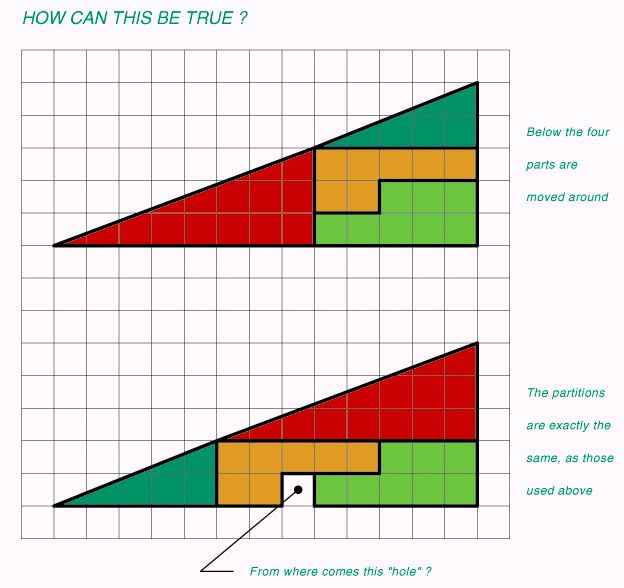
From where comes the hole!?!

For example: We go with the convention that right/up is positive and left/down is negative and we come up with the slope formula as above because it makes the most sense to do that. Well, what happens when you get a vertical line? Did it come from tilting your line more and more positive so that it is "the most positive you could ever get?" Or did it come from tilting your line the other way and making it more and more negative until it is "the most negative you could ever get?" From our basic understanding of positives and negatives these concepts are the two most opposite items we could think of with numbers, but here it stands visually as the same thing! At this point, we have two options. Accept the craziness of infinity and negative infinity and allow for weird things like that to happen OR redefine how we compute slope. Are we willing to come up with a more complicated way of computing a slope number that might resolve the infinity issue? Is there even a way to do that? It's an interesting conundrum.

There usually is a reason why math exists the way it does. Most of the math we teach in school has been around for hundreds, if not thousands, of years. It has resonated with people throughout cultures and time. But, at its root, the reason 1 + 1 = 2 is as deep as why the color red is more passionate than the color green.

Tuesday, March 1, 2011

The (Vampire) Tale of Calculus

The thing I love most about teaching calculus is that it seems to be the first course where it's easy to tell the story of the math. All the other courses leading into it seem to be a random collection of skills that are only loosely based on one another. For example, Algebra II (at least in our district) hops around from quadratics to exponentials to trigonometry, probability, systems of equations, and conics without much to tie them together.

Calculus flows very nicely, though.

We begin with our student adventurer moving to a new state and having to make new friends with abstract reasoning and rigorous work. Students find themselves walking along curves with limits only sometimes meeting their friends at an appointed spot and sometimes even walking towards a place that doesn't exist. The once familiar functions are treated as trivial, new functions are scarier and uglier than students thought possible making their much hated trig functions seem easy in comparison.

These infinitely (or infinitesmally) long walks along curves lead them to an otherworldly being: the derivative. At first the derivative is completely scary and unreasonable. "What does f(x+h) even mean?!" It's right there at the edge of their understanding and is beckoning them to come play, but has large wolverine-like teeth and is intimidating.

When students finally open up to the derivative's definition after walking the curves and even sometimes leaving the safety of the curves for tangents, they begin to see the true nature of derivatives. They discover the power rule. They are comfortable around the new creature, even when some of the scarier parts show up like the chain rule or even the quotient rule comes with a haunting melody to soothe its use.

Students finally let themselves fall in love with derivatives (which scarcely 2 months before none of them would've dreamed might exist) when it leaves them for a bit. Natural classroom forces tell students to leave the derivatives on the table while we go explore a new idea...

Their old friend, areas, come to visit. Brooding students want to return to derivatives as they begin to feel strange feelings towards Riemann sums, but we have left the derivative behind. Slightly different paths along accumulating functions where they step along thin rectangular blocks or trapezoidal strips lead them to a deeper appreciation of what area really means.

When students are finally beginning to forget about derivatives and are growing accustomed to loving the one they're with, the Fundamental Theorem of Calculus appears and reveals that these two supernatural beings are not only related, but at war with one another in an ancient struggle between infinities and zeros.

On the one hand, it is comforting to see the old derivative friend reappear. On the other, it is awkward to pair the old love with the new friend. The rest of the year is spent coming to terms with how the two relate and can become friends themselves.

Friday, February 4, 2011

Education Politics

I have no interest in getting into administration or being anything in education other than a classroom teacher. So, that's my personal background to this.

Anyhow, I pretty much stay out of all the politics in and around the school. Other teachers are in and out a lot, our district opens other schools and principals are being moved around, etc. I just don't really keep up with it.

There seem to be big changes going on at the state level this year (with Tennessee's influx of money from Race to the Top and proposed plans of how to spend the money), but I don't really keep up with it.

Basically, I love teaching and as long as I make enough money from it to live fairly comfortably, I'll do my best to take care of the kids who come into my room and progress their learning as much as possible. Maybe it's just optimistic to think the rest will take care of itself, but that's where I am.

Is that a crazy viewpoint?